 There is a growing conversation around AI in construction. Most of it sounds impressive; predictive analytics, digital twins, autonomous planning, fully integrated platforms. It promises a future where projects run with precision, clarity, and control.
But if you step onto an actual construction site today, that future feels distant.
The reality is much simpler. The site team is still:
Chasing information
Rewriting the same data in multiple places
Compiling reports from scattered sources
Making decisions later than they should
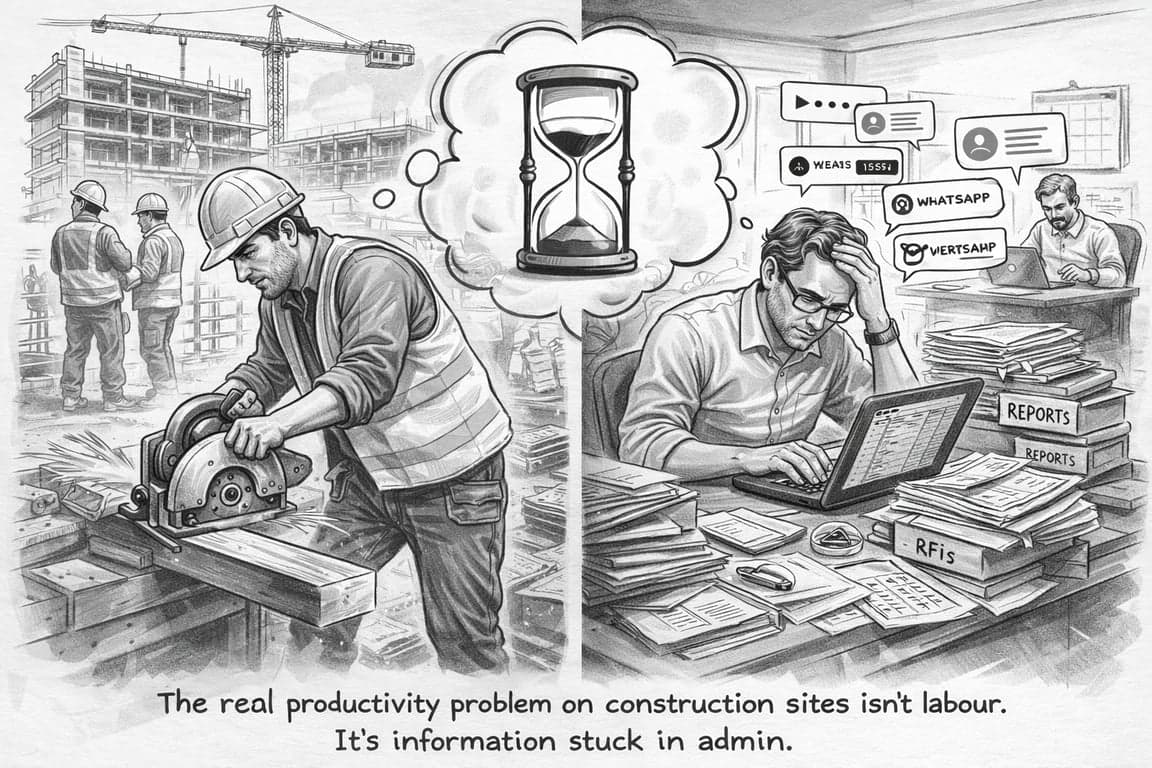
The inefficiency is not due to a lack of software. It is due to how information moves; or more accurately, how it doesn’t.
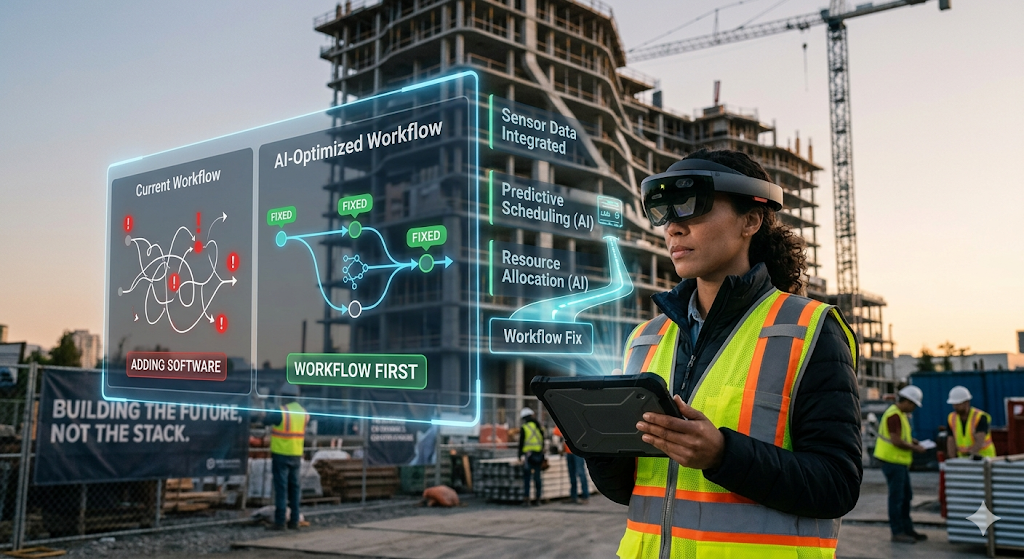
This is where AI has real value. Not as a new system to adopt, but as a layer that quietly removes the manual work already happening inside existing workflows.
The Wrong Way to Think About AI in Construction
Most discussions around AI start with the wrong question:
“What new system should we implement?”
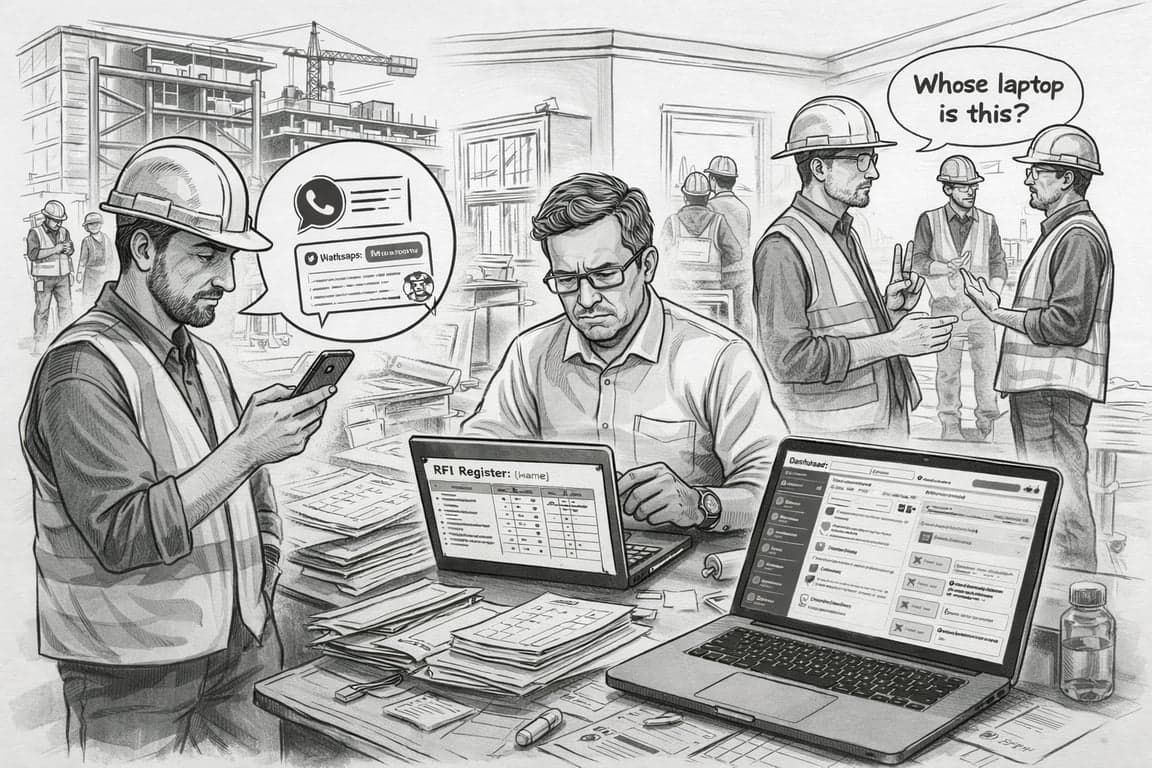
This is the same thinking that led to underused platforms, parallel workflows, and teams reverting back to WhatsApp and Excel.
AI does not need to replace anything.
The better question is:
“Where is time being spent repeating the same work; and how can that be done automatically?”
Because on most projects, the problem is not missing data. The problem is that the same data is:
Captured informally
Re-entered manually
Reformatted repeatedly
And delayed before it becomes usable
AI’s role is to eliminate that repetition.
Where AI Actually Fits on a Construction Project
If you observe a typical project closely, there are a few moments where information consistently gets stuck. These are not complex problems; they are small, repetitive bottlenecks that accumulate into significant inefficiency.
1. Daily Reporting
At the end of each day, information already exists:
Site progress
Manpower
Issues encountered
But instead of flowing directly into a usable format, it is:
Sent via WhatsApp
Noted verbally
Written in fragments
Then someone; usually the Project Manager or Engineer; spends time compiling it into a report.
AI changes this by capturing the same input and structuring it instantly.
A short message, a voice note, or a simple form submission can be:
Interpreted
Organised
Converted into a complete daily report
No additional work. Just a different outcome from the same action.
2. RFIs and Site Communication
RFIs are raised, tracked, followed up, and escalated; often manually.
The inefficiency is not in raising the RFI. It is in everything that happens after:
Logging it
Sending notifications
Tracking response deadlines
Updating registers
AI can automate this entire chain.
The moment an RFI is created, it can:
Register itself
Notify the relevant party
Set a response timeline
Trigger reminders
The engineer still raises the RFI the same way. The difference is that nothing gets stuck afterwards.
3. Progress Tracking and Lookahead Planning
Planning engineers often spend hours assembling lookaheads and progress updates from:
P6 exports
Site inputs
Verbal updates
This is not analysis. It is assembly.
AI allows this process to shift.
When data is captured continuously; even in simple formats; AI can:
Aggregate it
Align it with the programme
Generate draft lookaheads automatically
The planner’s role then becomes what it should have always been:
Reviewing
Interpreting
Anticipating risk
Not copying and pasting data.
4. Quality and Compliance Tracking
Inspection requests, NCRs, and QA/QC processes are often delayed not because of technical issues, but because of coordination gaps.
AI can ensure that once an action is triggered:
The record is created
The right parties are informed
The status is tracked
Escalation happens if needed
Again, nothing new is introduced.
The same action produces a more complete outcome.
The Principle: Capture Once, Use Everywhere
Across all these examples, one principle stands out:
Information should be captured once, and then flow automatically to where it is needed.
In most construction projects today, the opposite happens:
Information is captured multiple times
In different formats
By different people
AI enables a shift from duplication to continuity.
This is not a technology upgrade. It is an efficiency correction.
Why This Approach Works (When Others Don’t)
Traditional system implementations fail because they require behaviour change.
They ask people to:
Log into new platforms
Follow new processes
Learn new interfaces
AI, when applied correctly, does the opposite.
It works with:
Existing habits
Existing tools
Existing communication patterns
The foreman still sends an update.
The engineer still raises an issue.
The planner still reviews the programme.
But the system around them becomes:
Faster
More connected
Less dependent on manual effort
The Impact on Productivity (Where It Actually Matters)
When manual information handling is reduced, something important happens.
Time returns to the people who need it most.
The Project Manager spends less time compiling and more time deciding
The Planner spends less time assembling and more time analysing
The Engineer spends less time chasing and more time executing
This is where productivity improves; not on the ground, but in how the project is managed.
And when management improves:
Decisions are made earlier
Issues are resolved faster
Delays are identified sooner
The effect flows back to the site.
A Quiet but Important Shift
There is also a deeper implication.
When information becomes:
Timely
Structured
Traceable
You are no longer just improving operations.
You are strengthening:
Project records
Delay substantiation
Commercial position
Without changing how the team works, you are improving how the project is documented.
That matters more than most realise.
Where to Start (Without Changing Everything)
The mistake most companies make is trying to transform the entire system at once.
That rarely works.
A more effective approach is to start with one question:
“Where is time being spent repeatedly on the same task?”
Pick one:
Daily reporting
RFI tracking
Progress updates
Then:
Capture the existing workflow
Remove the manual steps
Let the process run automatically
Once one area works, the rest becomes clearer.
Final Thought
AI in construction does not need to be disruptive.
It does not require new platforms, new processes, or large-scale transformation.
Its real value lies in something much simpler:
Removing the work that should never have been manual in the first place.
The data is already there.
The workflows already exist.
The people already know what to do.
The only question is whether the system around them allows that work to flow; or keeps it stuck.
Because in the end, improving construction productivity is not about asking people to do more.
It is about finally allowing them to do less of what doesn’t matter.